Saturday, September 12, 2009

Gharial is an exclusive fish-eater.............. Not!

Gharial is now the most critically endangered large animal of South Asia with population reduction of >80% over 3 generations. With less than 200 breeding adults left in the wild, Gharial is one of the most endangered animals on earth.

Distribution of Gharials is now restricted to a few places in India and Nepal; the largest wild population being in National Chambal River Sanctuary and then in Katerniaghat Wildlife Sanctuary.

Gharials have a typical long and slender snout built for catching fish efficiently. They are exclusive fish eaters (?). They are a riverine species and are often seen basking out on banks with other animals like turtles and birds showing no fear from these 'harmless' creatures.

One of the breeding females at Madras Croc Bank. She is gorgeous. Photo by Katie Maxwell.

Super interestingly, on the morning of 2nd September 2009, Nick Ballantyne, one of our international volunteers working on temperature profiling of an enclosure housing Gharials and Batagur kachuga turtles, came back after his daily morning reading and said "I saw the male catch an egret!"

"Really? Wow man.When?" I was now putting in charged set of batteries in my cam.

"Just now. He still has it in his mouth" he said. 

WHOOSH! 

I had reached the enclosure, stunned by the sight.

A fledgeling Little egret (Egretta garzetta) was wandering close to water's edge in pen#24 (a.k.a. temple turtle pond). The male Gharial was keeping an eye on its constant movements. The egret was hopping on some of the partially emerged stones out of water. This made the Gharial curious and it came closer to investigate. The 'not-so-smart' egret thought Gharial's head was a stone and attempted to land. WHAM! The Gharial got it in his jaws! This could just be his reaction to the whole jumping-on-the-head thing. I have actually seen this before; in fact with the same animal. But then he let it go in the previous occasion. But this time he had some other plans!

Our male Gharial swallowing the egret!

I was taking pictures thinking that he'll probably spit out the egret in a while. Just then, he started swallowing it! I could not believe my eyes! I wanted to take a video of this but then the damn camera betrayed. I had to turn it off and then turn it back on. He had already swallowed the bird by then. I managed to get some good stills though.

"Amazing huh? Fish eater!" replied Gerry when I told him what I saw. This was so crazy.

"This is one of the weirdest things ever! This is the first record of its kind. Very important to make a note of it" said Rom

It was a m a z i n g seeing all this happen from a distance of 10 feet! AWESOME!

Saturday, September 5, 2009

CROCODILE TRAINING : PART TWO

“You’d know if they are enjoying the whole enrichment activity” said Ralf. I was wondering how. I was following one particular time everyday; 15:00, +/- 10 minutes. I started noting that they all would be doing some other stuff till about 14:50 and suddenly in 10 minutes, they would all ‘set up’ for the training.

After some intense training days, they all had chosen their ‘spots’ where they would come and wait for the training. There is no meat on Mondays so no training, but you could still see them getting ready at around 15:00 for the training! This means they are enjoying the activity. And they can calculate time of the day. More amazingly, they can also calculate day of the week! (This I found out later while working with some larger crocs.)

I was also following a fixed turn schedule for the group to be called out starting with Ally and then Pintoo, Thai, Komodo, Mik and lastly Abu. They remember that too and you can see the croc with the next turn getting ready to be called out! They were proving themselves smarter everyday (They still are!). This was getting more and more exciting for me everyday. I finally had a group of disciplined crocs coming out of and going in the water on my commands, and they were enjoying it. But I wanted to do more than just calling them out of the water. So what more can I possibly do?

“Make them jump out of water. The Saltie will love it.” suggested Ralf. What an awesome idea it was. I started calling them in one of the water pools and made them jump to get a piece of red-meat hanging from a bamboo stick. I tried this with all the five species. The Nile crocodile (Abu) and Mugger (Pintoo) didn’t show much interest or rather were not built for it. Ally liked it and would make a half-jump once in a while but then soon lose interest. The Saltie (Mik) and the Siamese crocs (Thai and Komodo) LOVED jumping out of the water and it seemed that they are perfectly built for it. Awesome! Amazing physical capability. We knew about the salties jumping out of water, but Siamese crocs are equally good.

Ally jumping out of water. Well, jumping half out of water!

Mik (Saltie) jumping out. She missed the meat in this jump.

Komodo (Siamese croc) jumping out. Bang on target!

I was so excited now. I had a bunch of crocs that would not only come out of and go back in the water, but jump out of water as well, all on my commands! Wow. I would regularly give updates to Rom whenever he visited Croc Bank. He was quite delighted with the whole idea of enrichment for crocs. He too was amazed with the learning capabilities (and some of the crazy physical capabilities of Siamese crocs). I will always be grateful to him for his encouragement and of course it wouldn’t have been possible without Ralf.  I am also thankful to Janaki who always advised to keep notes of this whole activity.

Now again, I wanted to do more than just calling them out, sending them back in and making them jump out of water. What next?

“Try interacting more with Ally. You can do a lot more with Alligators.” Ralf again suggested. Sure thing. I started interacting more with Ally. I also managed to desensitize her by patting her on the head saying “good girl” after every time she performed something right. I gradually desensitized her whole body. Now I do not have to worry about her reacting defensively (or aggressively) when I have to touch her body to check for any physical injury or anything else.

I thought why not do something like you do with dogs. It’ll be fun and will look rather cute with her. So, we started working on “sit”. It took about a week but then she figured out. She had to lay flat on her belly.

Me teaching Ally to "sit"

Pintoo was seeking attention now but since I was working on some new set of commands with Ally, I didn’t want to divide my concentration on anything else. There were also a few ‘surplus’ crocs who would come out randomly for food. Pintoo was the boldest croc in there and the smartest too, so he wanted to prove that he can do more stuff and he knew that he’d get food as reward. So he would come out and try to show his readiness for performance. I didn’t want to neglect him completely so I thought of “stay” as his next command. He took only a couple of days to figure that out. All of my commands have a tap-on-the-snout with a small bamboo stick. For “stay” he had to freeze in whichever place he was tapped “stay”. While I was working on that, I saw Ally mimicking “stay” like Pintoo! She would just come up as if asking to tap on her snout. I tapped on her snout and said “stay” and she just froze! I could not believe my eyes.

Ally performing "stay"

Later I taught them to perform “stay” with their mouth open as it looks much more impressive that way.

Getting back to Ally, she would now come and “sit” but it looked incomplete. She should now stand. I chose “up” as the command word just to keep it simple for her. We started working on that. Again it took about a week. Now with the command “up”, she has to stand up raising her head high.

Ally performing "up"

I would follow this up with a pat on her head. “Good girl Ally”. People who have seen this often say “Oh she seems to really enjoy that pat on her head”. I am sure she does. She is awesome.

"Good girl Ally"

She loves to eat and so I have to act as her dietician keeping a check on her food intake. I want fit crocs, not fat crocs, and this goes for all crocs. Their food intake is strictly monitored. One more problem I faced during the initial days when they didn’t have a fixed turn schedule was that the crocs would randomly come out and ask for food while I was working with some other croc. This was often irritating as they would ruin my concentration and distract the croc I was working with. This would become dangerous when they grow bigger and should not be encouraged. I often had to have one more person in the enclosure who would keep an eye and send back any such ‘off training’ crocs while I was working with one. First Nikhil, then Gowri and later Seth (one of our keepers) played this vital role. After about a month of this, they all knew their turns and were quite ‘disciplined’. I started working alone again.

END OF PART TWO.

To be continued...


Friday, August 28, 2009

CROCODILE TRAINING : PART ONE

Enrichment of captive animals is essential to keep them happy and healthy. Broadly, enrichment can be behavioural and environmental. For reptiles, environmental enrichment is most common, although I haven't seen a lot in Indian zoos unfortunately. This enrichment typically includes providing a close to nature habitat (environment) and other physical components that will encourage and allow natural behaviour; for eg. perches, logs, rocks, misting, waterfall, different smells, leaf litter, etc. This article will revolve around behavioural enrichment of crocodiles. "Training" as a part of behavioural enrichment had been the most successful tool. It allows the animals to 'do something' and hence gives some relief from the otherwise extremely boring life in captivity. I will talk more about this as we proceed.
___________________________________________________________

“We should start training our crocodiles” mentioned Ralf Sommerlad (Croc expert from Germany and ex-director - MCBT) one day. I was not sure how to react. Train crocodiles? Really? What does he possibly mean by that?
I was amazed by just the thought (if it is possible at all). I knew training was possible to a certain extent with lizards; monitors especially. I had tried my hands on monitors earlier but never really got into it. I also recalled a video on youtube of a guy who had managed to train a Box turtle! Of course it took him a long time; 9 years! But still he did train a turtle. But how would crocs do? I was not sure about the whole training thing. I started thinking maybe it’s just behavioral conditioning and not “training” as you do with dogs. I had loads of logical questions to which Ralf would patiently answer.
“Would you like to try training a few crocs and see it for yourself?” Ralf asked one day.
“Oh yes! I’d love to do that” I was very happy with that offer. Unfortunately, there isn’t a lot of information available on how to train crocs. “This is still an upcoming trend in zoos keeping reptiles” Ralf would say. Sure it was. I had heard about it for the first time. Ralf guided a lot in the initial days.


“Once you get the hold of it, you will have to take it forward your way” He would say.


We started looking for ideal candidates for training. Nikhil (Curator - MCBT) suggested trying out the sub-adults (of five species) that were recently transferred to a large enclosure from nursery. Good Idea.

Target group - sub-adults of five species

I started working with Ally, the female sub-adult American Alligator, as she was already reacting to her name. She was handled regularly when she was smaller. People would call out her name all the time so she kind of knew her name. But now she was not handled for a long time. The first thing to do was to win her trust.

Crocodiles in general are quite shy animals. It is only with some behavioral conditioning (associate a particular activity, on completion of which animal gets a reward – usually food) that they become a bit bold. Young animals are even more wary. They probably see humans as predators and here in a captive scenario, a source of food, nothing more. Winning trust of such animals is surely a bit tricky.


Me trying to win Ally's trust

“Ally come” I would shout showing her a fish to lure her. Command words are very critical. The main idea is to associate certain activities to a cue, sometimes a combination of cues. Once they perform the activity, they get a reward – in this case red meat. This is taking behavioral conditioning to the next level where you can get a croc to do almost anything that it is physically capable of doing. I choose my words carefully. Cues can be vocal, visual and touch. I never knew these things till I actually saw them reacting to everything. “You should never mix up the cues or you’ll confuse them ” Ralf advised.

Anyway, getting back to Ally’s training, “You will first have to reinforce her association with her name. She should react every time you call her” said Ralf. And how do you do that? “Call her name and reward her with a piece of meat”. So here I go calling her “Ally” and throwing a piece of meat, which she gulped down really fast.  After a couple of days, she came to the water’s edge when called. That was amazing. She was reacting to her name so well! I was excited.


Regularity is one more important factor. When starting such a training program, the key is to do it very regularly, almost every day. On day four, Ally came out of the water. Wow. She now trusts me and is pretty confident that I won’t hurt her. While she was coming out, I shouted “Ally come, Ally come”. I gave her a reward. “Good girl Ally”.
“Now tap gently on her snout and send her back to water” Ralf said. “Ally water, Ally water” I said while sending her back in the water. “Now give her a reward again”. This was too amusing for me. I loved doing it. I did this everyday at 15:30. I continued this for a week. Everything was going very smooth. Every day I would notice a mugger come to the edge of the water and watch everything carefully. On day 8, I called out “Ally come” and Ally came out. Well, quite unexpectedly, the mugger also came out and sat right next to Ally as if imitating her exactly. I was speechless! “He could be your next student. Name him something” shouted Ralf. I called him Pintoo! After sending Ally back in water, I turned to Pintoo and said “Pintoo water” and he went back straight in water. That was AMAZING. They learn by watching others! I had never imagined crocs could be so smart. “Great job Soham. You just got your second student. ” Awesome! Now I had two crocs coming out of water and going back on my ‘commands’.


I now started to look for more interested individuals. Soon enough I had “Mik” – a Saltwater Crocodile, “Thai” & “Komodo” – Siamese Crocodiles, “Abu” – Nile Crocodile, and of course “Ally” and “Pintoo” coming out and going back in the water. All of these animals were now perfectly conditioned.


Training group with Ally in the water


END OF PART ONE.


To be continued...


Saturday, April 18, 2009

Vulture visits the hospital!

This happened in Februay 2006. We were entering the bird section of our rehab center for some follow-up treatment of birds that had some major wing injuries. We were quite amazed to see a juvenile Egyptian vulture (Neophron percnopterus) sitting right on top of the treatment room. I had no clue why would a random Vulture come and sit on such a low height for no apparent reason. Mr. Sarfraz Malik (A true Falconer and Raptor Guru) was then working with us. We felt it was a pretty strange thing for a wild Vulture to come and sit like that. We expected that it would fly away in a while but that didn't happen. It kept on sitting there for more than an hour! May be the bird has some problems. It was also strange that it was tolerating human presence quite a bit. We decided to catch it for further examination.

Sarfrazbhai came up with a plan to noose the bird. This method has worked earlier in a similar situation but is only tried with raptors (with heavy strong necks). Special soft cotton thread was chosen for the purpose to minimize possible injuries. The above photo shows Sarfrazbhai preparing the noose.


We attempted the noose but in vain. Interestingly, inspite of the attempts, the bird didn't bother to escape away. It did step back but no efforts of flying away. 


I thought of trying out my plan. So I got a ladder to take a closer look at the bird.


I wasn't able to see the bird properly as it had stepped back and the ladder was too small. So, I thought may be luring  it with some meat might work. So I got a chunk of juicy red meat and attempted to lure it. It was surely interested in that. It took a step forward.


One step was not enough. I had to get a bit closer. So I distracted it with that piece of meat while I was struggling to get some more height. Sarfrazbhai and an animal keeper were helping me maintain my balance.


The Vulture was now within my (striking) range and that was probably my only chance. One (really) fast sweep and caught the Vulture!


After the safe capture I passed on the bird to Sarfrazbhai and then got down from the ladder myself. I was feeling quite proud of catching a wild Vulture with my 'bare hands'. 
Handling Vultures of the Gyps family may leave some great looking scars on your body. Their beak is build to tear open tough skin and human skin is not so tough as you find out during the bites.
It was most difficult when they have to be captured everyday for their post surgery follow-up treatment. Initially they are housed in a 'restricted activity' cage which is really small to prevent any unwanted injuries in attempts to fly. Taking them out from such small cages is some work, especially when there are over 25 such Vultures for the daily treatment.


Getting back to our story. When we did a general physical examination on the captured bird, we found it had kite-string injuries on the right wing.


Wait a minute, I know this bird!
This Vulture was hand-raised at our rehab center and was released last year!!!! I used to tag all my released birds and this guy had the tag!


How and why did it come exactly to the rehab center after incurring an injury is still a mystery.
Amazing huh?

Thursday, March 26, 2009

Backyard Bay

We (Croc Bank gang) are fortunate enough to have the Bay of Bengal as our backyard!

It is a great refreshing experience in the mornings (forcefully by Casper and Akanksha) and in the evenings. 


I have seen loads of weird creatures, shells, fishes, eels, etc. washed ashore.  Also not to forget the hundreds of crabs running around. But sometimes there are more interesting things to see!

I am trying to recall some such experiences.

Croc Bank is involved in Sea turtle nesting survey covering the beach adjacent to our facility. “Turtle walk” is an educational program offered to spread awareness about Sea turtle conservation.These walks serve dual purpose as we take small group of people along with us for the surveys.The turtle walk also consists of some other activities before the walk like educational talks, ppt, documentary, night safari, etc. On the walks, we try to take GPS locations of nests, dead turtles, light disturbances, etc. If we find a dead Sea turtle, we try and take the morphometrical data depending on the condition of the carcass.

With a lot of luck one might see a Sea turtle nesting. And I guess that was a lucky day. We came across a nesting female! She was huge. I didn’t want to disturb her so I directed to switch off all the white-light torches. I turned on my red torch (rather a normal torch with a red plastic film on it; works equally well!). Sea turtles and a few other reptiles are known to be more tolerant of high frequency lights, which is orange to red. I took the reading (Garmin Vista ecX is goood!) and we left her to her tiring job. We completed the 4km long walk which includes answering all the queries by the turtle walk participants. The walk ended but the work didn’t.There are a few egg poachers around and with the tractor-like drag marks anybody can make out where the nest is. So, as a part of our duty, we went back and wiped out all the drag marks! We did our best to camouflage the nest and wished it good luck. That was one of my first such experiences and was truly amazing. The walk back at 01:00 am was quite tiring though.

_______________________________________________

One morning I had just finished taking temperature readings of the Draceana (Caiman lizards) enclosure and was passing by the counter office. Mr. Mohan (our accountant), was pretty excited when he said that one of our gatekeepers saw some Sea turtle hatchlings on the beach in the morning.

I went “WHAT? WHERE? TODAY?”

I immediately requested him to get hold of that guy and ask him to take me to the exact spot where he saw the hatchlings. I wanted to take a reading of the location on our GPS. This was immensely important for our survey. I came back in a flash with the GPS, note and a pen.

While walking towards the place, I was thinking of possibilities of seeing some of the hatchlings. We do have some light disturbances on that part of the beach. Some of them might have been disoriented due to this and must have headed towards wrong directions. I guessed that was the reason why that guy found some hatchlings in the morning. We reached the spot and sure enough we found a hatchling trapped / exhausted in the casuarina plantation. We started searching and found 5 dead and 4 live hatchlings. As the temperature rises it becomes difficult for the already exhausted hatchlings to survive. 

Two of the live hatchlings were trapped in a piece of abandoned fishing net. 

 We managed to released them all back in the bay. We searched for more but couldn’t find any.

I've been lucky enough to see Eretmochelys imbricata (Hawksbill sea turtle) on a couple of occassions. Unfotunately both were dead and had washed ashore.

_______________________________________________

We had one “celebrity” turtle walk. Participants were famous VJs from local channel (S.S. Music). They had some great luck. We took some rest after reaching half way. The walk was getting rather boring as we hadn’t seen anything so far. People were asking about probabilities of seeing something. I kept on saying “I can’t guarantee anything but there’s always a possibility”.

We had just started walking and our local guide Mohan shouted “Baby, baby. Baby turtle” He almost stepped on one!

“Baby! Wow! Search for more. Everyone spread out. Search for more hatchlings. Make sure you don’t step on one.”

One by one we collected 31 hatchlings. Now I wanted to search the nest (again for the GPS location). It took around 25mins to successfully lay our hands on the nest. I also wanted to count the number of eggs. So we dug out the nest and counted 71 eggs that had hatched out and 45 infertile eggs. In all 116 eggs! That is a big clutch from probably a big female. The photo on the left shows how the hatchlings instantly get attracted towards artificial lights, in this case it was my torch while I was making some notes.


_______________________________________________

 One morning my alarm (Casper) forced me to get up and go for a walk on the beach. I was still quite sleepy and could have done with at least 2 more hours of sleep. While walking towards South, I could see some House crows pecking at something. My eyes turned into binoculars and my mind was making the vague image clearer as we were closing towards it.

I shouted “Sea snake! And moving” and ran. I had to stop as Casper was following me. He’d be in big trouble (or anyone else in that case) if bitten by a Sea snake with very little information available about the venom and no anti-venom serum around. As expected, it was a Enhydrina schistosa (Hook-nosed sea snake); about 3ft in length, not very big for that species. You often come across awesome stuff and don’t have the camera with you; at least I do. I excitedly requested (if “Go, run and get the damn camera” is a request) Akanksha to get the camera, which she hurriedly did. 
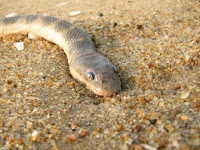


I managed to get some good photos and then let it go back into the bay.

Apart from above I have seen dolphins playing very close to the beach once. (One more first for me!)

I am fortunate that I get to do and experience what once was no more than a dream for me. The greatest thing is that these experiences are part of my job and / or time-pass! It is truly great to be here.

I love my backyard bay. It’s awesome!

Thursday, March 19, 2009

A nocturnal Rat snake!


I think I can never get used to getting amazed by the natural world even though it happens very frequently.
We (the Croc Bank gang) had gathered in the canteen for dinner. I think the time was around 08:45pm. One of our watchman came and told us that he had seen a snake near the puppet theatre. I (as usual) got really excited and ran towards the puppet theatre only to recall that we need a torch to see! I came back to my room, got a torch, a snake hook and our dustbin (I took it because I was in a hurry + there was no container available + this bin had a lid and was good for a container!).
So soon we rush to the place and I could not believe my eyes. A Rat snake (Ptyas mucosa) feeding on a toad at 08:45pm!!!
That can't be right. I must go closer. I knew I can't mistake a Rat snake from 2 feet away but it still took some time to accept the fact that it was indeed a 6 - 6.6 ft Rat snake!
We didn't want to disturb it so we just left it alone and came back but THAT IS STRANGE. I wouldn't have believed it if I had not seen this with my own eyes. That is something I have never seen or heard or read (I don't read much though).
Like I said in my early articles, I was engaged in problem reptile removal activities. I must have caught at least 700 Rat snakes from strangest of places. I have caught them from people's bedrooms, kitchens, backyards, roofs, factories, cars, motor bikes, trees, etc. etc. Once I was called to remove a Rat snake from the Kitchen of a restaurant situated on the second floor right in the middle of the one of the busiest market place. 
No doubt they are highly adaptable and do survive in some of the strangest of urban habitats. People often say "how can a snake live in a city???" Well, they were always there when it was a jungle once. They were always there when it was turned into a farmland and then into a village and further on to a town and now an "urban city". Since they are so adaptive by nature, it is not at all difficult for them to survive in such environment. You just see them once in a while because of their way of living which is highly secretive. They were always there and they will be always there. There is not a single colony in new Ahmedabad from where we have not found snakes, year after year. We find snakes of all age and eggs during the breeding season, again year after year. This means that they have completely adapted themselves. There is always enough prey base for them most of which is rodents and insects followed by toads/frogs and lizards (thanks to our solid waste management system). What the residents (humans) might want to do is just learn to live with them! Seems tough with all sorts of misunderstandings but that is the only real solution.
We now know that removing snakes from one location and "releasing" in another "good habitat" (translocation) is not a good idea. Studies suggest that most of the translocated snakes die within a year of release. > I will be writing a full article on this so keep following. <
Coming back to the main subject of this article; all of the Rat snakes that I have caught were only during the day time which is fine as they are strictly diurnal snakes. There are snakes which are active by day and night, also sometimes called "Bi-diurnal" but not Rat snakes. I have kept Rat snakes in captivity for educational shows for a long time but I have never seen them active after dark.
The above is a photo of "Gabbar" with Akanksha at our rehab center. She is the largest Rat snake I have ever caught / kept. She was 8.6ft which is huge for a female. She was the star in many of our educational shows.

I think the after dark feeding behavior of a Rat snake here shows the amazing adaptational capabilities. There is no other explanation to this as the snake was feeding on a toad on a clear ground. It was really dark then. It obviously didn't just bump into a toad and started eating it. That was a proper hunt it had made. Croc Bank campus has a lot of frogs / toads and this could well be a switch in the feeding behavior which can and will result in the wellbeing of the snake by out-competing all the other duirnal predators. That is one smart snake!

Oh by the way, it might be interesting to know that all colubrid snakes including Rat snakes are venomous. They have true venom glands producing true venoms (not 'Duvernoy's gland' as it was earlier reffered to). Some of the species have venoms as complex as elapids and viperids.
For more information on this visit http://www.venomdoc.com/ and click on "colubrids". You can also find the paper published by Dr. Bryan Greg Fry here.